Evaluating Financial Performance with SPC-LOPCOW-MARCOS Hybrid Methodology: A Case Study for Firms Listed in BIST Sustainability Index
DOI:
https://doi.org/10.59543/kadsa.v1i.13879Keywords:
Financial Performance, Real Sector Firms, SPC, LOPCOW, MARCOSAbstract
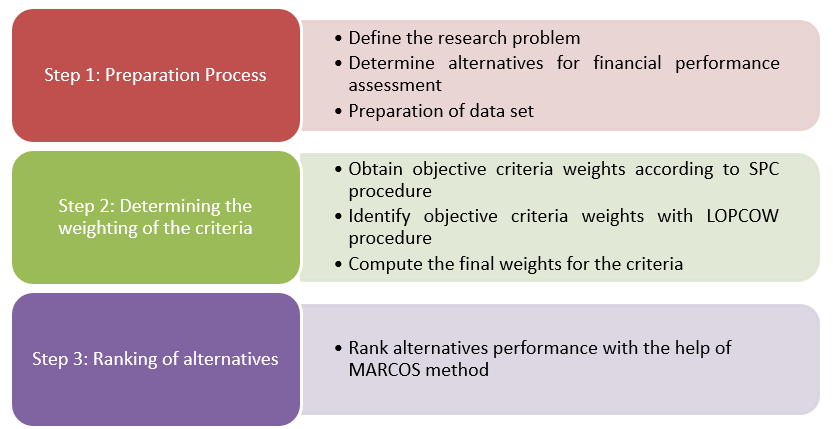
By periodically analysing financial performance, manufacturing companies can enhance their operational efficiency, manage risks effectively, make strategic decisions, maintain a competitive advantage, ensure sustainability, and promote good corporate governance. This research introduces a new decision approach for computing and ranking the financial performance, employing financial ratio metrics. In other words, this research proposes a novel decision framework for measuring firm performance, incorporating the Symmetry Point Criterion (SPC), Logarithmic Percentage Change Based Objective Weighting (LOPCOW) and Measurement of Alternatives and Ranking by Consensus Solution (MARCOS) approaches. The applicability of this proposed decision framework is assessed via a real-time case study in the current research. The case analysis in question focuses on the financial performance of 16 real sector companies whose shares are traded in the Borsa Istanbul (BIST) Sustainability 25 Index (XSD25) for the year 2023. To analyse the financial performance of the real sector companies, 10 financial performance indicators were chosen based on previous literature. SPC and LOPCOW procedures are applied to identify the final importance weights of the performance indicators, and the MARCOS procedure is employed to rank the firms. The results of the final weighting procedure show that the three most important criteria are the ratio of total debt to total equity, the return on equity, and the average price-earnings ratio. Based on the MARCOS ranking methodology, it was concluded that ENKAI was the company with the highest financial performance compared to its rival companies during the analysis period.